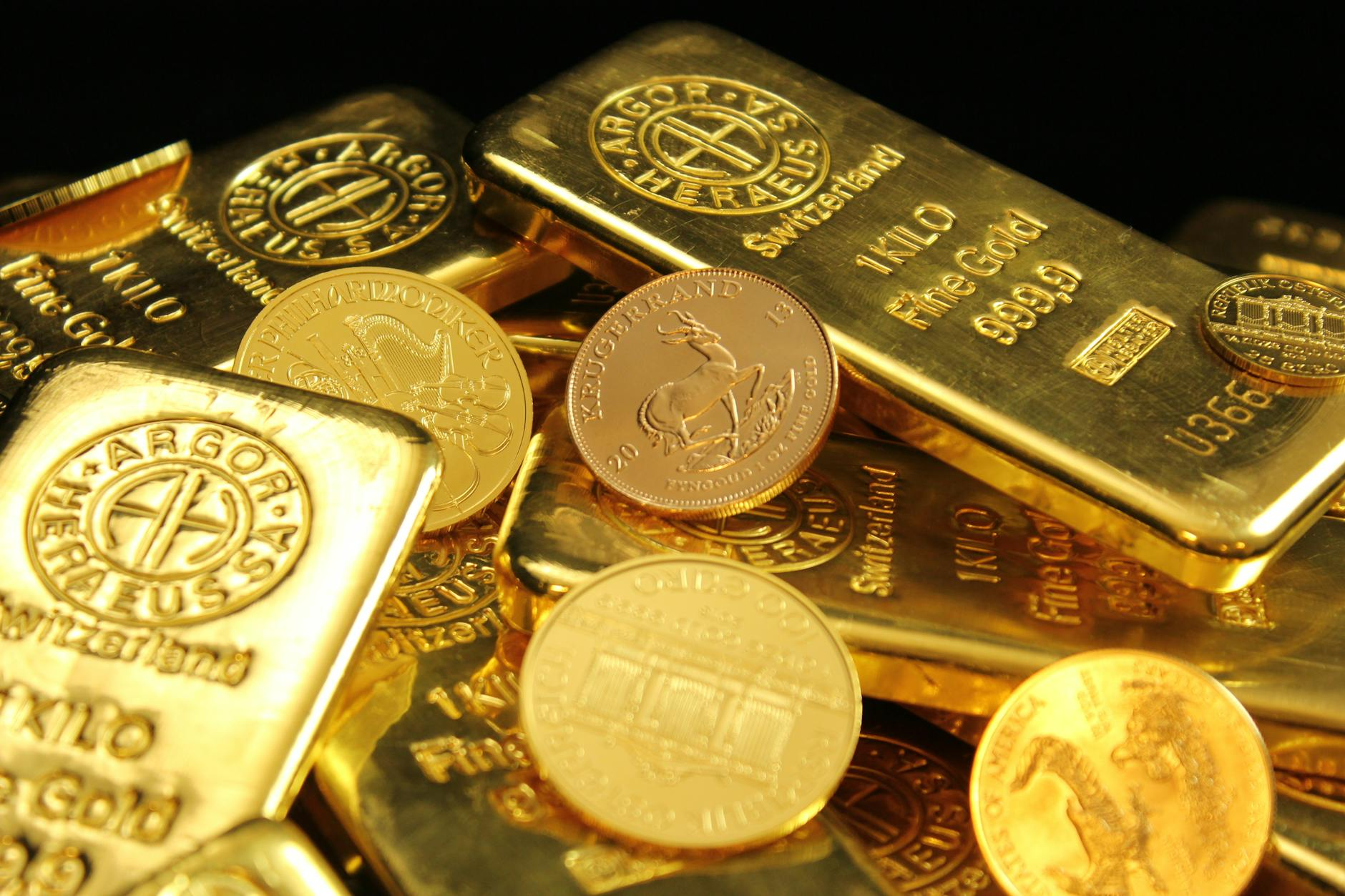
Gold: The Very Beginning of Value
Long before people spoke of banks, interest rates, or digital payments, there was something humans noticed almost instinctively. When light touched it, it responded—holding the glow of the sun and the warmth of fire in a way few natural materials did. Even when drawn from deep underground after centuries of silence, it appeared unchanged, as if time itself had passed it by.
Gold did not need explanation. It did not need permission.
Before it became money, it first became attention.
In a world surrounded by stone, wood, and earth, gold stood apart. It did not rust, rot, or fade. It could be shaped without breaking and melted without losing its essence. Its presence felt deliberate, almost intentional, as though nature itself had marked it as different.
Long before humans learned to count or measure, they noticed this difference. Long before value had numbers attached to it, gold felt valuable. This was not economics. It was instinct.
Before Money Had a Shape
Before money had a name, a symbol, or a shape, exchange was deeply physical. Value moved from hand to hand through things people could see, touch, and use. People exchanged things like rings, cattle, salt, and tools, which they considered important. Trade worked—but only up to a point.
The difficulty was not exchange itself, but comparison. What felt fair in one moment could feel unequal in another. A ring might matter more to one person than a sack of grain did to another. Cattle could not be divided without losing their purpose, and salt, though valuable, could spoil or be lost. Value had to be stable and universal.
As trade expanded beyond villages and familiarity, this uncertainty grew. People needed something that could carry value without changing its nature—something that could be divided, stored, and moved without losing meaning. They were not yet looking for money, but they were searching for convenience.
Gold began to quietly fit that need. It did not replace these earlier forms of exchange immediately, nor was it declared superior. It simply endured where other things failed. It could be kept without fear of decay, divided without losing identity, and carried across distances while remaining recognizable. Moreover, its glitter made it anything but unvaluable.
At this stage, gold was still not money. It had no stamp, no authority, and no promise attached to it. People across races, cultures, languages, and regions accepted it as the embodiment of value.
When people thought about gold, they thought about value.
When Weight Became Worth
As gold spread across regions, people began to understand that its value did not lie in shape or ornament, but in how much of it there was. A thin piece and a thicker piece could look similar, yet feel very different in the hand. What mattered was weight.
Trade slowly moved to balances and scales. Gold was placed on one side, stones or metal weights on the other, and agreement followed when the scale settled. Trust no longer depended on familiarity or negotiation; it depended on measurement.
Different societies created their own weight standards. In Mesopotamia, metals were measured in shekels as early as 3000 BCE. In the Greek world, larger values were expressed in talents, weights used to describe vast wealth and state finances. The drachma, later known as a Greek coin, also began as a unit of weight before taking a fixed form. In ancient India, gold was measured using small units like ratti and later tola, where even slight differences in weight mattered.
Gold itself had no fixed form at this stage. It was cut, melted, and weighed repeatedly. Value was no longer just felt—it was measured. Without rulers, stamps, or laws, weight became the first quiet standard of trust.
From Weight to Coin: The Lydian Turning Point
As human civilizations grew, trade expanded exponentially. Long-distance trade exploded, and markets grew more crowded. Weighing metal for every transaction became slow and impractical.
That turning point came in Lydia (present-day western Turkey), around the 7th century BCE. In this region of the ancient world, metal was shaped into small, standardized pieces and stamped with official symbols. These early coins were not yet pure gold; they were made from electrum, a natural mixture of gold and silver. What mattered was not their composition alone, but the idea behind them. For the first time, value was issued, measured, and guaranteed by a public authority.
Under King Croesus of Lydia, this system evolved further. Gold and silver were separated and minted into distinct coins of known weight and purity. This was a decisive moment in monetary history. Gold no longer needed to be tested or weighed in daily trade. Its value was recognized instantly, carried by the coin itself.
Coins transformed gold from measured metal into trusted money. They made value portable, repeatable, and recognizable across markets and borders. Trade became faster, simpler, and less dependent on personal familiarity. Weight had given gold credibility. The stamp gave it trust.
When Paper Entered the Story
As trade expanded and economies grew more complex, carrying large quantities of metal coins too became increasingly impractical. Coins were reliable, but they were heavy, difficult to transport in bulk, and risky to move across long distances. Merchants and states needed a lighter, more flexible way to represent value.
Paper money emerged as a solution. At first, paper notes were not money by themselves. They were receipts—claims on gold or silver stored elsewhere. A piece of paper could represent a fixed amount of metal held in a vault, usually stamped by the ruler or the State. This allowed value to move without the metal itself changing hands. This made trade faster, safer, and more scalable.
But paper introduced a temptation that metal never had. Unlike gold, paper could be created easily. When governments needed more money, they printed more notes than the metal they represented, the link between money and value weakened. Over time, excess printing reduced purchasing power, and prices began to rise. Such excess money created resulted in deriding inflations in many economoies
This tension defined the age of paper money. It offered convenience and reach, but only remained stable when discipline was maintained. When that discipline failed, trust eroded.
The question was no longer whether paper could represent value—but what would ultimately anchor it.
Gold as the Anchor of Money
To resolve this tension, societies turned back to what they already trusted.
Paper could move value efficiently, but it needed something solid beneath it. Gold filled that role. Instead of circulating through markets, it moved into vaults, becoming the quiet foundation on which paper promises rested. Gold acted as an anchor rather than a tool of daily exchange. Governments and kingdoms tied their currencies to gold reserves, ensuring that money issued had a tangible backing.
By the late 19th century, many major economies formally adopted what came to be known as the classical gold standard. Under this system, national currencies were directly defined in terms of gold. Each unit of currency represented a fixed quantity of gold, and governments committed to convert paper money into gold on demand.
For example, in Britain, one pound sterling was defined as approximately 7.32 grams of gold. In the United States, one dollar was fixed at about 1.5 grams of gold, corresponding to an official price of $20.67 per ounce before World War I. Other countries set similar fixed gold parities for their currencies.
This system imposed discipline. Governments could not issue unlimited money without holding sufficient gold reserves. In this way, gold acted as a natural restraint on excess printing and circulation of paper money
The Bretton Woods Moment
After two world wars, the global monetary system was in disarray. Currencies had been devalued, gold reserves were unevenly distributed, and trust between nations was fragile. The world needed a system that could bring stability without returning fully to the rigid gold standard of the past.
In 1944, representatives from 44 countries gathered in a small town in the United States called Bretton Woods. Their goal was not to abandon gold, but to redesign its role.
Under the Bretton Woods system, gold was fixed at 35 US dollars per ounce. The U.S. dollar was made directly convertible into gold, while other currencies were pegged to the dollar. Even when gold sat at the center of the system, the status of the U.S. dollar rose above all other currencies.This arrangement created a balance. Gold provided credibility, while paper money provided flexibility. Exchange rates became more stable, international trade expanded, and economies began to recover.
Gold no longer moved through markets or into people’s hands. It remained in central bank vaults, acting as the silent foundation of global trust. For a while, this system worked—not because gold was everywhere, but because belief in it still acted as an anchor.
When Money Let Go of Gold
As decades passed, the balance created at Bretton Woods became harder to maintain. Global trade expanded rapidly, governments spent more to rebuild and grow their economies, and the demand for U.S. dollars increased far beyond the gold reserves that supported them. The system relied on confidence—but that confidence was being stretched.
By the late 1960s, foreign governments and central banks began to worry whether the United States actually held enough gold to back all the dollars in circulation. Instead of holding paper currency, some countries started exchanging their dollars for gold. As more countries demanded gold, U.S. gold reserves began to shrink, and confidence in the system weakened.
In 1971, U.S. President Richard Nixon announced the suspension of the dollar’s convertibility into gold. This decision—often called the Nixon Shock—effectively ended the Bretton Woods system. With that move, money was no longer tied to any fixed quantity of gold.
Other countries had little choice but to respond. Nations that had pegged their currencies to the U.S. dollar gradually allowed them to float freely against one another. Fixed exchange rates gave way to market-driven ones, and the global monetary system shifted toward full fiat currency, where money derived its value from trust in governments rather than in any precious metal.
Gold did not disappear from the system, but its role changed fundamentally. It was no longer the rule that governed money creation. Instead, it became something separate—an independent reference against which paper money could be compared
Gold in Times of Uncertainty
Throughout history, moments of uncertainty have followed a familiar pattern. Wars, economic crises, currency failures, and political instability weaken confidence in systems built on promises. When that happens, people instinctively look for something that does not depend on policy decisions or political authority.
Gold has repeatedly filled that role.
After the collapse of the Bretton Woods system in the early 1970s, the world entered an era of floating currencies and greater financial volatility. Inflation surged in the 1970s, particularly in the United States, eroding the purchasing power of paper money. During this period, gold prices rose sharply, reflecting a loss of confidence in fiat currencies.
Similar patterns appeared during later crises. In 1987, when global stock markets crashed in a single day, gold retained its appeal as a store of value. During the Asian financial crisis of 1997, when currencies and banking systems across Asia collapsed, gold once again acted as a refuge. The pattern repeated during the 2008 global financial crisis, when major banks failed, markets plunged, and trust in financial institutions weakened. As equities collapsed, gold prices held firm and later climbed as uncertainty deepened.
The same instinct surfaced during the COVID-19 crisis. In early 2020, markets faced a sudden shock, liquidity tightened, and fear spread globally. As uncertainty rose and central banks responded with extraordinary stimulus, gold regained strength and reached record highs during the pandemic period, reflecting renewed demand for the historical trusted store of value.
Gold does not promise growth or returns.It promises stability. That is why, even today, central banks continue to hold gold, and nations quietly increase their reserves during uncertain periods. Gold’s importance rises not because it changes, but because circumstances do. In moments when confidence fades, gold does what it has always done—it hold
Gold in a World of New Assets
The modern financial world offers choices that earlier generations never had. Alongside traditional assets, entirely new forms of value have emerged—most notably decentralized cryptocurrencies such as Bitcoin. These assets appeal to a familiar instinct: the desire to hold value outside the control of governments and central authorities.
That instinct is not new.
For centuries, people who doubted rulers, policies, or distant institutions turned to gold for the same reason. Gold did not depend on law or decree. It could not be printed, altered, or devalued by authority. In this sense, gold and decentralized cryptocurrencies share a common philosophical foundation: both exist beyond direct government control.
Yet there is an important difference. Decentralized cryptocurrencies represent a new experiment in trust—built on code, networks, and collective belief in technology. Gold represents something older. Its trust was not engineered; it was earned. Over thousands of years, across empires, collapses, inflations, and crises, gold has repeatedly proven that it can preserve value when systems change or fail.
That is why gold continues to hold a distinct place. It is not simply outside control; it is proven outside control. Its resilience over centuries has embedded it deeply in human trust, culture, and memory. New assets may redefine how value moves. Gold reminds us how value has survived.
Still the Safe Haven
Today, the world of money is crowded. Stocks promise growth, real estate promises security, paper currencies keep economies moving, and newer forms—cryptocurrencies, decentralized systems, and stablecoins—promise speed, autonomy, and innovation. Each plays a role in the modern financial landscape. Yet when uncertainty rises, when systems strain, and when confidence begins to fade, attention quietly shifts away from the noise.
Gold stands in the story of money like a tower of resilience—not built overnight, not shaped by trends, but strengthened layer by layer through time. Empires have been built over it, kings have fought over it, and men have died for it. Gold has many stories to tell.
In moments of crisis, people do not turn to gold for excitement or novelty. They turn to it as a last resort, a safe haven, a place of stability when everything else feels uncertain. When markets fall and promises weaken, gold becomes a beacon—visible, steady, and familiar.
Gold does not command trust by force. It earns it through endurance. Its resilience is not theoretical; it has been tested repeatedly across centuries of human history. That is why, even in a world filled with chaos and rapid change, gold continues to set the tone.